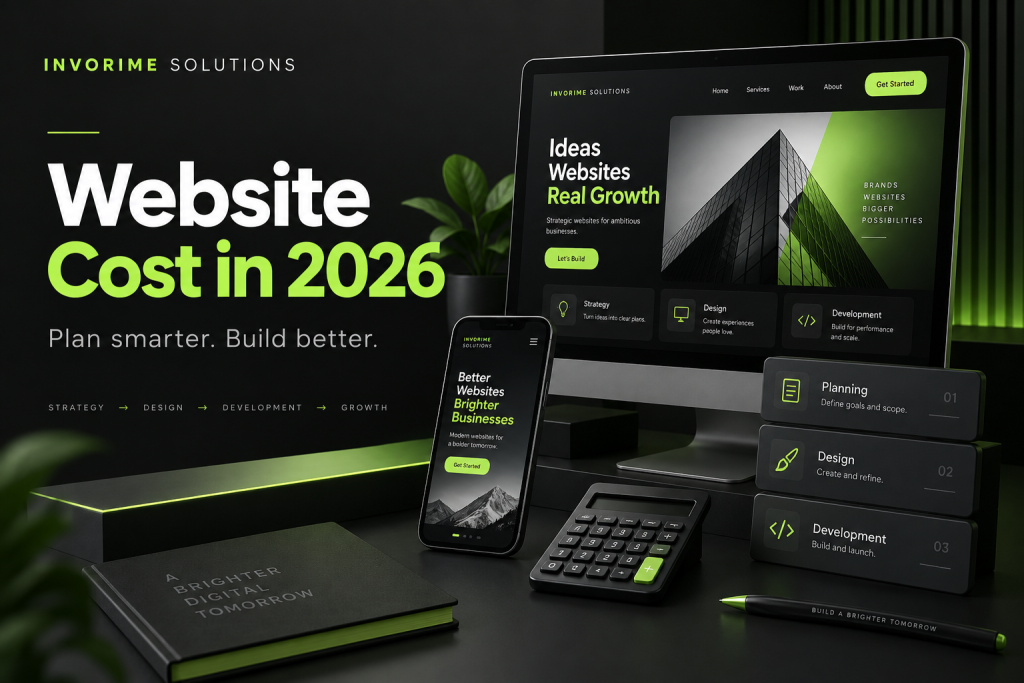
How much does a professional website cost in 2026? The honest answer depends on what your website needs to do. A focused business website and a custom platform with customer accounts, payments, and integrations are very different projects.
For a useful market reference, Clutch’s 2026 web design pricing guide reports agency project prices spanning roughly US$2,000 to US$100,000, with most reviewed projects costing less than US$10,000. That broad range is a starting point, not a quote for your business.
This guide from Invorime Solutions explains what drives the price, how to compare proposals, and how to plan for costs after launch. All monetary examples below are in USD and are illustrative; they are not Invorime Solutions package prices or guaranteed market rates.
What are you paying for when you hire a professional?
A website is more than a collection of pages. Your investment can cover planning, content structure, visual design, development, testing, and launch support. The proposal should explain exactly which of these are included.
Start with the business outcome: do visitors need to request a quote, book an appointment, buy a product, or evaluate your work? A clear goal helps your team choose the right features and avoid paying for extras that do not support the customer journey.
Professional website cost by project type
A focused small-business website
A brochure or service website usually introduces the business, explains its services, shows proof of its work, and provides a contact route. Costs stay easier to control when the page count is modest, content is ready, and a small set of reusable layouts can support the site.
Ask whether the price includes mobile layouts, contact-form testing, basic search settings, and training to edit the content. A low initial quote can become less attractive if those essentials are separate.
A custom marketing website
A growing business may need distinct service pages, case studies, landing pages, and a more tailored visual identity. Custom layouts, copywriting, photography, and CRM connections can increase the work involved. The number of unique page designs often matters more than the total page count.
An e-commerce website
An online store adds product structure, payment setup, shipping rules, order emails, and checkout testing. Product variations, subscriptions, inventory connections, and migration from an existing store can add complexity. Separate the build fee from platform subscriptions, paid extensions, and payment-processing charges.
A portal or custom web application
Customer dashboards, role-based access, booking logic, and connections to business systems need detailed requirements. These projects benefit from a discovery phase before a firm development quote. Budget for testing, security work, documentation, and ongoing support as part of the scope.
Seven factors that change the price of a website
1. Scope and functionality
A standard enquiry form is different from a multi-step quotation tool. List the workflows users must complete, the systems involved, and the information each feature needs to handle. Clear requirements make estimates more meaningful.
2. Design and brand readiness
Existing brand guidelines and approved assets reduce uncertainty. A new visual identity, custom illustrations, or extensive animation adds design time. Explore Invorime Solutions’ design and development services when deciding whether branding and website work should be planned together.
3. Content and page structure
Someone must write the service descriptions, prepare images, and organize the navigation. Confirm who supplies the content and how many revision rounds are included. Copywriting, translation, and moving a large content library should appear explicitly in the proposal.
4. Platform and integrations
Compare platforms against your editing needs and required features. Ask about recurring licences, ownership, and the cost of connecting tools such as a CRM or booking system. A platform that is inexpensive to start may still require paid extensions or specialist support.
5. Search foundations
Define the SEO deliverables rather than accepting a vague promise of an “SEO-friendly website.” Useful items to discuss include page titles, meta descriptions, logical headings, internal links, image descriptions, and redirect planning for a redesign. Ongoing content and SEO work are separate from setting up the site, and no build can guarantee a search ranking.
6. Quality assurance and accessibility
Allow time to test navigation, forms, mobile layouts, keyboard use, and key customer journeys. Confirm which browsers and devices the team will check and how it will handle issues found before launch. Specific acceptance criteria are more useful than a promise that everything will be perfect.
7. Delivery schedule and support
Urgent deadlines, multiple decision-makers, and changing requirements can affect the budget. Agree on feedback deadlines, revision limits, and a written process for additional work. Also distinguish the post-launch defect-fixing period from paid maintenance and new features.
Ongoing website costs to include in your budget
The launch invoice is only part of the total cost of ownership. Before committing, request a separate list of recurring charges and their renewal dates:
- Domain registration: the website address and its renewal cost.
- Hosting or platform subscription: including storage, backups, and any usage limits.
- Software licences: themes, plugins, extensions, and connected tools.
- Maintenance: updates, monitoring, restore support, and agreed response times.
- Content and marketing: new pages, articles, campaign landing pages, and ongoing SEO.
- Store operating costs: payment fees and any apps or services needed to run sales.
Check introductory prices against renewal prices. Ask which accounts you own, which costs you pay directly, and what happens if you change providers.
A simple example of a first-year website budget
Use this formula: first-year budget = one-time build + annual running costs + planned additional work + contingency.
For illustration, a US$4,000 build, US$600 in annual running costs, and US$900 for planned content or improvements total US$5,500. Adding a US$550 contingency gives a planning budget of US$6,050, before any applicable taxes or transaction fees. These are example inputs, not a service offer; replace each figure with a written quote.
This approach makes it easier to compare two proposals that bundle services differently. A higher build fee may include work that another provider charges for separately.
How to compare website quotes fairly
Send every provider the same brief and ask for a written breakdown. Check the following before choosing:
- Page count, unique layouts, and included functionality.
- Who provides copy, images, and product information.
- Design revisions, approval stages, and delivery assumptions.
- Mobile, accessibility, performance, and functional testing scope.
- SEO setup and any content migration or redirects.
- Ownership of the domain, hosting account, design assets, and website access.
- Training, launch support, maintenance terms, and recurring fees.
- Exclusions and the process for pricing changes.
Review relevant examples as well as the price. You can explore Invorime Solutions’ projects to start a discussion about the style and functionality your own site needs.
How to control costs without weakening the website
Prioritize the pages and features needed for launch. Prepare your content early, nominate one person to consolidate feedback, and reuse suitable page layouts. Put optional features into a later phase with a separate budget.
Keep the main conversion path simple. For a service business, clear service information and an easy enquiry process may matter more than elaborate animation. For a shop, product clarity and a tested checkout deserve attention before decorative extras.
Frequently asked questions
Is a WordPress website cheaper than a custom website?
Not automatically. WordPress can support reusable themes and familiar editing tools, but custom design, integrations, and maintenance still take work. Compare the complete scope and ongoing costs rather than assuming the platform name determines the price.
Does website design pricing include hosting and SEO?
Sometimes, but you should never assume it does. Ask for an itemized proposal that separates the build, hosting, SEO setup, ongoing marketing, and maintenance. Confirm the renewal cost of anything included for an introductory period.
Can I launch with a smaller budget and expand later?
Yes, if the initial plan supports your likely next steps. Agree on the essential launch features and identify what can wait. Discuss future requirements early so the first version does not create unnecessary rework.
How do I get an accurate website quote?
Share your business goals, target audience, approximate page list, essential features, existing content, preferred launch date, and budget range. Include a few reference websites and explain what you like about them. A clear brief reduces guesswork.
Plan your website with Invorime Solutions
Your website budget should match your business goals and the experience your customers need. Invorime Solutions brings together web design and development, UI/UX design, and branding to help shape that experience.
Ready to discuss your project? Contact Invorime Solutions to request a tailored website quote. Tell us what your business does, what visitors should be able to do, and when you would like to launch. We can start with the scope and identify the next steps for your website.